
Core professional capability
Protective Surveillance in Close Protection
Protective surveillance plays a critical role in modern close protection. Rather than reacting to incidents, professionals use pattern recognition and environmantal awareness to identify risk early, understand environments clearly, and support prevention before threats escalate. As a result, this approach strengthens decision-making, reduces exposure, and increases overall operational control.
In close protection, it is not a specialist add-on. Instead, it forms a core professional capability within the broader close protection discipline that supports planning, movement, and situational awareness across every assignment.
What is protective surveillance?
Observation of people, environments and patterns
Protective surveillance is the structured observation of people, environments, and patterns to support the safety of a protected individual. In close protection, professionals use it to recognise normal behaviour, identify anomalies, and assess potential risk without drawing attention.
Rather than relying on technology or force, it prioritises awareness, discipline, and judgement. Consequently, it allows operatives to act early and discreetly, often preventing incidents before they materialise.
Why protective surveillance matters in close protection
Enables prevention
First and foremost, protective surveillance enables prevention. By understanding what “normal” looks like in a given environment, professionals can detect subtle changes that indicate elevated risk. As a result, teams gain time,the most valuable resource in protection.
In addition, surveillance directly supports travel security planning, route selection, and movement decisions, especially in unfamiliar or dynamic environments.
Ultimately, it reduces surprises. Instead of responding to sudden threats, professionals anticipate challenges and shape outcomes in advance.
Protective surveillance vs counter-surveillance
Each serve a different purposes
Protective focuses on understanding the environment. It supports prevention by identifying risks, monitoring behaviour, and informing planning and movement.
Counter-surveillance, on the other hand, focuses on detecting hostile observation. Professionals use it when there is a realistic possibility that a principal or team is being watched or targeted.
While both disciplines support safety, protective operates continuously and proactively. Counter-surveillance activates more selectively, based on threat indicators. Understanding this distinction allows professionals to apply the right approach at the right time.
How protective surveillance works in practice
Combination of observation, awareness, and discretion
Protective surveillance works through a combination of observation, awareness, and discretion. Rather than relying on rigid procedures, professionals apply these principles fluidly across environments and in direct support of proactive movement and formations.
Observation, patterns, and anomalies
To begin with, it starts by establishing an effective and behavioural baselines. Professionals observe how people normally move, interact, and behave within a specific setting.
Once a baseline is clear, anomalies become visible. These deviations may include unusual movement patterns, inconsistent behaviour, or misplaced attention. Consequently, professionals can assess risk early and decide whether adjustment is required.
Awareness, positioning, and discretion
In addition, the situational observation depends on maintaining awareness without exposure. Professionals position themselves to observe effectively while blending naturally into the environment.
Through discretion, operatives avoid drawing attention to themselves or the principal. As a result, it supports movement, planning, and coordination without disrupting normal activity or increasing visibility.
Frequently asked questions
Learn more
What is protective surveillance in close protection?
- It is the proactive observation of people and environments to identify risk early and support prevention in close protection operations.
How is protective surveillance different from counter-surveillance?
- Protective focuses on understanding environments and behaviour, while counter-surveillance focuses on detecting hostile observation.
When is protective surveillance used?
- Professionals use it continuously, before and during operations, to support planning and situational awareness.
Who should learn protective surveillance?
- Benefits applied to experienced professionals, aspiring operatives, and educators involved in close protection and executive protection.
Explore further
Raise your quality
Learning the principles strengthens awareness, supports prevention, and improves professional judgement. When learned and applied correctly, it allows close protection professionals to operate calmly, decisively, and discreetly across diverse environments.
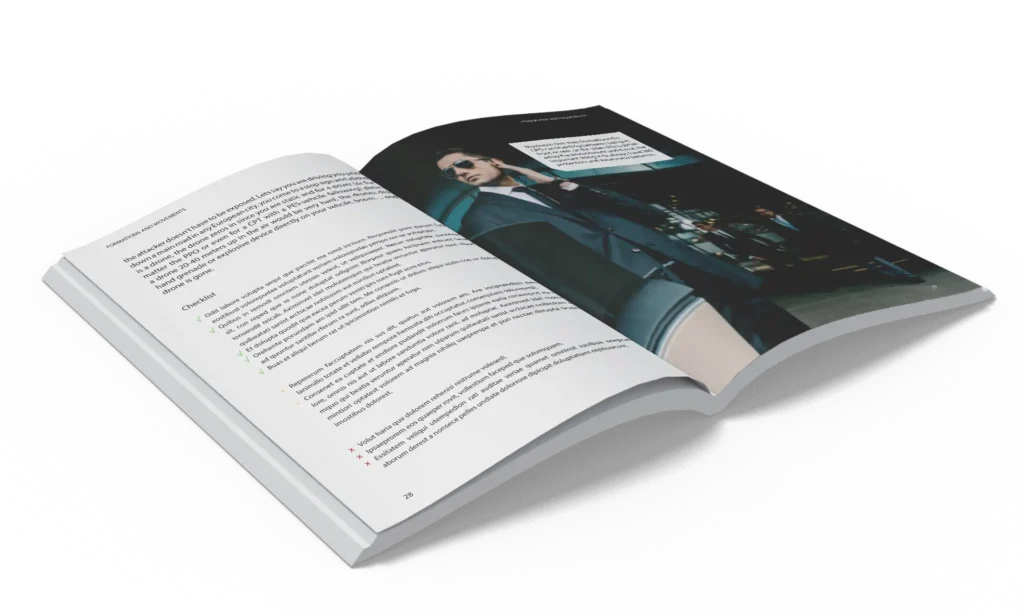
The Close Protection Handbook brings these principles together, offering clarity, context, and practical insight that professionals can return to throughout their careers. The handbook is published in collaboration with an experienced partner.